
Machine learning has become one of the most important technologies shaping the modern digital world. From personalized recommendations on streaming platforms to voice assistants, online shopping suggestions, fraud detection systems, and medical research, machine learning is influencing many areas of everyday life.
Although the term may sound complex, the basic idea behind machine learning is simple. It allows computers to learn from data, identify patterns, and improve their performance over time without requiring direct programming for every specific task.
As businesses, researchers, and technology companies continue adopting artificial intelligence solutions, understanding machine learning has become increasingly valuable. This beginner-friendly guide explains what machine learning is, how it works, different types of machine learning, real-world examples, benefits, challenges, and its future possibilities.
What Is Machine Learning?
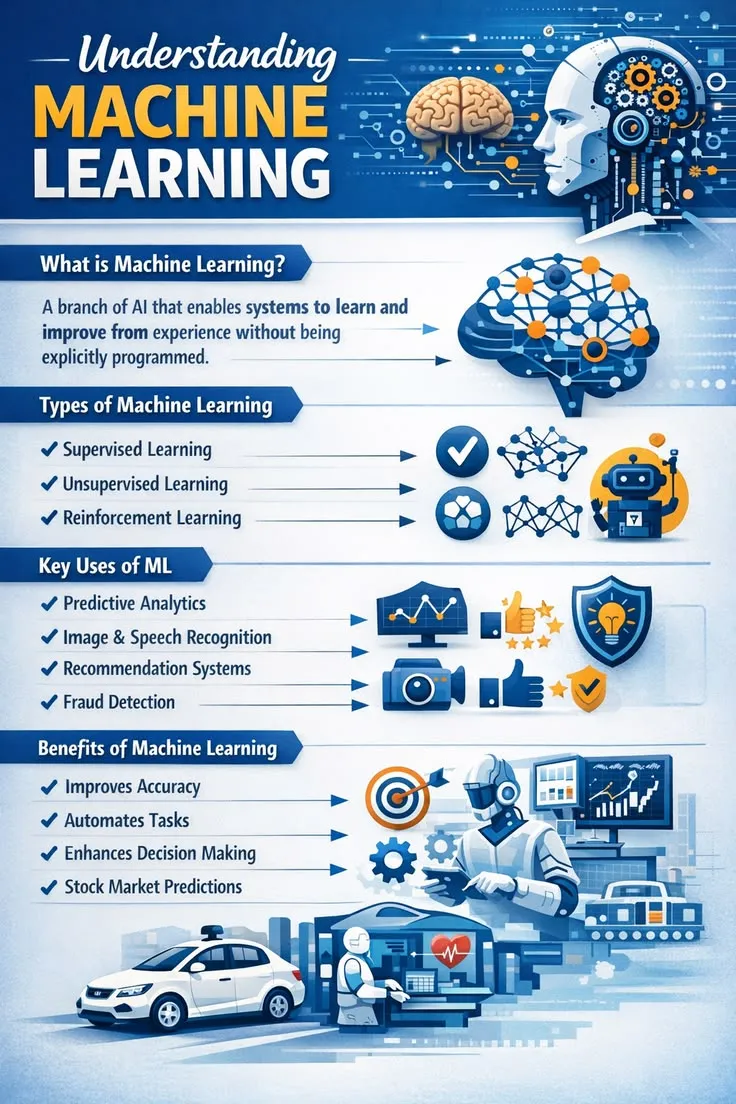
Machine learning is a branch of artificial intelligence that enables computers to learn from data and make decisions or predictions without requiring explicit instructions for every situation.
Traditional computer programs work according to fixed rules created by developers. In comparison, machine learning systems analyze large amounts of information, discover patterns, and use those patterns to improve their results.
For example, instead of manually creating rules to identify every possible spam email, machine learning algorithms can analyze thousands of emails, understand common characteristics of unwanted messages, and automatically recognize spam content in the future.
The more accurate and relevant data a machine learning model receives, the better it becomes at identifying patterns and making predictions.
How Does Machine Learning Work?
Machine learning works by combining data, algorithms, and statistical techniques to train computer systems. The process begins with collecting relevant information, which may include images, text, numbers, customer activities, sensor readings, or other forms of digital data.
After collecting data, machine learning algorithms analyze it to identify relationships and patterns. During the training process, the system learns from examples and improves its ability to make accurate predictions.
Once trained, the machine learning model can process new information and provide results based on what it has learned.
For example, an online shopping platform can analyze previous purchases, searches, and browsing behavior to predict products that a customer may be interested in buying.
Simple Example of Machine Learning
A common example of machine learning is email spam detection.
Traditional email systems required programmers to create specific rules, such as blocking messages containing certain words or suspicious phrases. However, spam messages continue changing, making fixed rules less effective.
Machine learning systems solve this problem by studying thousands of examples of spam and normal emails. The system learns patterns related to suspicious links, unusual wording, sender behavior, and message structures.
After analyzing this information, the system becomes capable of identifying unwanted emails more accurately and improving its performance over time.
Types of Machine Learning
Machine learning is mainly divided into three major categories: supervised learning, unsupervised learning, and reinforcement learning. Each method uses different approaches to help computers learn from data.
Supervised Learning
Supervised learning is one of the most commonly used forms of machine learning. In this method, computers are trained using labeled data, which means the correct answers are already provided during training.
The algorithm studies examples and learns how to make predictions based on previously identified patterns.
For example, if a computer system is trained with thousands of images labeled as cats and dogs, it learns the differences between these animals. After training, it can analyze a new image and predict whether it contains a cat or a dog.
Supervised learning is commonly used in areas such as image recognition, medical analysis, customer behavior prediction, and fraud detection.
Unsupervised Learning
Unsupervised learning works with data that does not contain predefined answers or labels. Instead of being given correct results, the system analyzes information independently and discovers hidden patterns.
For example, an online business may use unsupervised learning to study customer behavior and identify different groups of shoppers based on purchasing habits.
This helps businesses understand customers better and create more personalized services.
Unsupervised learning is commonly used for market research, customer segmentation, and discovering patterns within large datasets.
Reinforcement Learning
Reinforcement learning is a method where machines learn through trial and error. The system interacts with an environment and receives rewards or penalties depending on its actions.
Over time, it learns which actions produce better results.
A simple example is teaching a computer program to play a video game. The system tries different strategies, receives feedback, and gradually learns how to improve its performance.
Reinforcement learning is used in robotics, automation, gaming technology, and advanced decision-making systems.
Real-Life Applications of Machine Learning
Machine learning is already a part of many technologies used in everyday life.
Recommendation systems on streaming platforms and online shopping websites use machine learning to suggest products, movies, or content based on user interests. These systems analyze previous activities and predict what users may prefer in the future.
Voice assistants use machine learning to understand human speech, recognize commands, and provide relevant responses. These systems continue improving by learning from user interactions.
Navigation applications also depend on machine learning to analyze traffic conditions, estimate travel times, and recommend better routes.
In healthcare, machine learning helps analyze medical information, support research, examine medical images, and assist professionals in making informed decisions.
Banks and financial institutions use machine learning to detect unusual transactions, identify fraud patterns, and improve financial security.
Difference Between Artificial Intelligence and Machine Learning
Artificial intelligence is a broad field focused on creating machines capable of performing tasks that usually require human intelligence, such as problem-solving, understanding language, and decision-making.
Machine learning is a part of artificial intelligence that focuses on enabling computers to learn from data and improve automatically.
In simple terms, artificial intelligence is the larger concept, while machine learning is one of the methods used to create intelligent systems.
Benefits of Machine Learning
Machine learning offers several advantages across different industries. One of the biggest benefits is automation, as machines can perform repetitive tasks quickly and efficiently.
It also improves decision-making by identifying patterns and trends that may be difficult for humans to detect manually.
Businesses use machine learning to understand customers, improve operations, reduce costs, and provide personalized experiences.
Another major advantage is the ability to process large amounts of data quickly, helping organizations make accurate predictions and solve complex problems.
Challenges of Machine Learning
Although machine learning provides many benefits, it also has certain challenges.
The quality of data plays an important role in determining the accuracy of machine learning systems. Incorrect, incomplete, or biased data can affect results.
Privacy and security are also important concerns because many machine learning applications depend on collecting and analyzing large amounts of information.
Developing machine learning systems requires technical knowledge, advanced computing resources, and continuous improvement to maintain accuracy.
Future of Machine Learning
The future of machine learning is expected to bring more advanced and useful applications. Improvements in algorithms, computing power, and data availability will continue making machine learning systems more accurate and efficient.
Machine learning is expected to play an important role in areas such as healthcare innovation, cybersecurity, smart transportation, automation, personalized education, and business intelligence.
As technology continues evolving, machine learning will become an even more important part of digital transformation across industries.
Conclusion
Machine learning is a powerful technology that allows computers to learn from data, recognize patterns, and make intelligent decisions. Although the technology behind it is advanced, the basic concept is simple: machines improve their performance by learning from experience.
From recommendation systems and voice assistants to healthcare, banking, and transportation, machine learning is already transforming modern life.
Understanding machine learning helps individuals and businesses prepare for the future of technology. As artificial intelligence continues growing, machine learning will remain one of the most important technologies driving innovation, automation, and smarter solutions worldwide.
