
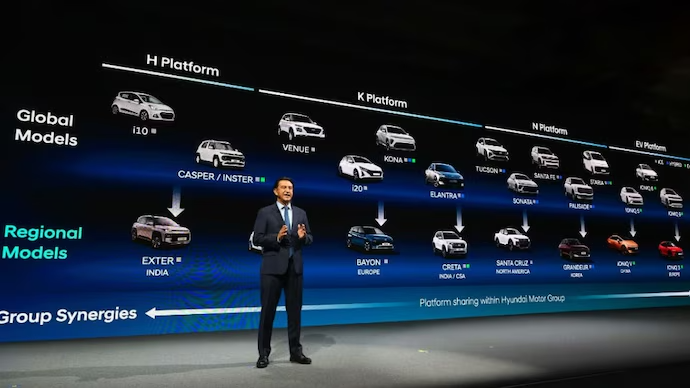
Hyundai is preparing for one of its biggest product expansions in India, with the company planning to introduce or update 26 models by 2030. The strategy covers electric vehicles, petrol-powered SUVs, new technologies, manufacturing expansion and a stronger export focus. The first major product under this plan is expected to arrive before the end of 2026.
The upcoming Hyundai new EV will be a small electric SUV designed with Indian buyers in mind. It is expected to sit below the Creta Electric and could become an important model for Hyundai as demand for relatively affordable electric SUVs continues to grow. The company is also working on a new midsize SUV with an internal-combustion engine, while several other launches and updates are planned over the next few years.
Hyundai’s 26-Model India Roadmap
Hyundai’s latest India strategy is much broader than simply adding a few new cars. The company has outlined a plan involving 26 new models and updates through 2030, covering different segments and powertrain technologies.
The first product is expected in the fourth quarter of 2026. It will be a compact electric SUV developed specifically around the requirements of the Indian market. This is important because Hyundai already sells the Creta Electric, but the upcoming model will target customers who want something smaller and potentially more accessible.
The company is also expected to refresh existing products while introducing completely new models. That could give Hyundai a wider presence across compact SUVs, midsize SUVs, electric vehicles and other passenger-car segments.
Globally, Hyundai is targeting more than 100 new or updated models by 2030. India is therefore becoming an important part of a much larger international product strategy.
New Electric SUV Arrives First
The biggest immediate development for Indian buyers is the upcoming small electric SUV. Hyundai has confirmed that the model is being developed specifically with India in mind, and test vehicles have already been seen on Indian roads.
The company has not yet revealed important specifications such as battery capacity, claimed driving range or motor output. That means buyers will have to wait for the official unveiling before making comparisons with rival electric SUVs.
However, some technology details are already known. The upcoming EV is expected to receive Hyundai’s next-generation infotainment system along with Level 2 ADAS features.
Its positioning could be particularly interesting. The vehicle will sit below the Creta Electric, giving Hyundai another entry point into the electric SUV market. A smaller size and increased localisation could also help the company keep costs under control.
For Hyundai, this model is not simply another EV launch. It is expected to play a role in making electric mobility available to a wider group of Indian customers.
Another SUV Is Coming
Hyundai’s product offensive will not be limited to electric vehicles. The company is also developing a new midsize SUV powered by an internal-combustion engine.
Testing of the upcoming SUV is already taking place in India. Its final positioning has not been completely disclosed, but it could sit below the Creta or operate alongside it depending on the final dimensions, equipment and pricing strategy.
The vehicle is understood to take some inspiration from the Bayon sold in international markets. However, the India-spec version is expected to receive significant changes rather than simply becoming a direct copy of the overseas model.
Hyundai is also considering different powertrain choices for this SUV. One possibility is a factory-fitted CNG version. If Hyundai brings such an option to production, it could become an interesting alternative for customers looking for lower running costs while still wanting an SUV body style.
The CNG possibility also makes strategic sense because several competitors are already expanding their CNG SUV portfolios.
Production Capacity Gets Bigger
Launching 26 models will require considerably more manufacturing capability. Hyundai is therefore planning a major capacity expansion in India.
The company plans to add around 3.2 lakh units of annual production capacity by 2030. Once completed, its total installed capacity in India is expected to reach approximately 14.3 lakh units per year.
This expansion is not only about serving domestic demand. Hyundai wants India to become an even more important manufacturing and export base.
The company is also targeting around 90% local content for vehicles manufactured in India by the end of the decade. Greater localisation can help reduce dependence on imported components and potentially improve cost competitiveness.
More than 1,400 domestic suppliers and over 900 local engineers are expected to support this wider localisation strategy.
India’s Export Role Will Grow
India already plays an important role in Hyundai’s global manufacturing network, but the company wants to increase that importance further.
Around 30% of vehicles produced locally are expected to be exported to overseas markets under the long-term plan. These exports could serve customers across Asia, Africa, the Middle East and South America.
This means future Hyundai models developed or manufactured in India may not necessarily be intended only for Indian customers. Local production could increasingly support multiple international markets.
The export strategy also gives Hyundai another reason to increase localisation. A stronger domestic supplier network can make Indian production more competitive globally, especially when the company is producing models for several markets from the same manufacturing base.
That could gradually change India’s position within Hyundai’s worldwide operations.
Genesis Could Enter India
There is another interesting development connected with Hyundai’s India strategy. Genesis, Hyundai’s premium luxury brand, is preparing for expansion into India and other Asia-Pacific markets.
While a precise launch date has not been officially confirmed under the latest roadmap, an India entry is expected around 2027.
Genesis would give Hyundai a presence in a much more premium part of the market. The move could also help the group compete against established luxury manufacturers if the brand introduces the right products and builds a strong sales and service network.
The company is targeting global Genesis sales of around 3.5 lakh units annually by 2030, making expansion into additional markets an important part of its long-term strategy.
Hyundai Also Eyes Electric Three-Wheelers
Hyundai’s India ambitions extend beyond conventional passenger cars. The company is also entering the electric three-wheeler space through a partnership with TVS Motor Company.
Under the collaboration, Hyundai will be responsible for vehicle design, while TVS Motor will handle manufacturing of the electric three-wheelers.
The partnership shows how Hyundai is looking beyond traditional cars as India’s mobility market changes. Electric three-wheelers have significant potential in urban transportation, commercial use and last-mile mobility.
For Hyundai, the project could also provide another opportunity to develop products suited specifically to Indian operating conditions.
What Buyers Can Expect Next
For Indian car buyers, the most immediate development is the compact electric SUV expected in Q4 2026. Its price, battery size, driving range and exact launch date remain key details that Hyundai is yet to reveal.
After that, attention will move toward the new midsize SUV and the broader sequence of launches planned through 2030.
The important point is that Hyundai is not betting on one type of vehicle. The company appears to be preparing a mixed portfolio that includes EVs, conventional powertrains, possible CNG models, refreshed products and premium vehicles.
That approach could prove useful in India because customer preferences remain divided across different fuel technologies. While electric vehicles are gaining attention, petrol, hybrid, CNG and other powertrains continue to have their own markets.
Hyundai’s plan therefore looks less like a complete shift away from traditional cars and more like an attempt to cover multiple parts of India’s changing automotive market.
A Bigger Hyundai By 2030
Hyundai’s India roadmap signals a much more aggressive phase for the company. The planned 26 models and updates, additional manufacturing capacity, higher localisation and stronger exports all point toward India becoming an even more important part of its global operations.
The upcoming small electric SUV could be the first major test of this strategy. If Hyundai manages to combine competitive pricing, useful range, modern technology and strong localisation, the model could become an important addition to the growing electric SUV market.
At the same time, the new midsize SUV, potential CNG options, Genesis expansion and electric three-wheeler partnership show that the company is preparing on several fronts.
By 2030, Indian customers could therefore have a much wider Hyundai portfolio to choose from. The next few launches will reveal whether this ambitious product strategy can translate into stronger sales, greater EV acceptance and a larger role for India in Hyundai’s global plans.
Read More :- globe-wander.com
