
In a remarkable display of endurance and coordinated rescue efforts, a Chinese national was pulled alive from a hydropower tunnel in Nepal on Saturday, ten days after devastating floods and mudslides swept through a Himalayan valley. The survivor, identified as Luhaitao (also referred to as Lu Haitao), emerged from approximately 225 meters inside a tunnel at the Upper Trishuli-1 Hydropower Project. This breakthrough came one day after two Nepali workers were rescued from a separate tunnel on the same river system, renewing hopes amid one of the region’s worst natural disasters in recent years.
The disaster struck on August 26 when a massive glacial collapse high in the mountains unleashed a powerful surge of ice, rock, mud, and water. The torrent raced through river valleys, particularly along the Bhotekoshi and Trishuli rivers near the Nepal-China border, destroying infrastructure, burying communities, and trapping hundreds of workers inside hydropower tunnels. Official figures indicate more than 1,300 people lost their lives, with over 5,600 reported missing across the affected areas. Hundreds of those missing were workers connected to multiple hydropower projects, many of them foreign nationals.
Dramatic Tunnel Rescue at Upper Trishuli-1
Nepali Army personnel, working alongside foreign disaster experts including a team from South Korea, located Luhaitao inside Audit Tunnel 4 of the 216-megawatt Upper Trishuli-1 project in the Rasuwa-Nuwakot region. Rescuers extracted him from a point roughly 225 meters (about 738 feet) into the tunnel. Video and images released by the army show the exhausted man, his skin and clothing coated in dried mud and dust, being supported by uniformed rescuers. He was immediately given emergency medical attention inside a helicopter and flown to an army hospital and barracks for further assessment.
Army statements confirmed that his health was under evaluation while search operations continued at the site and other locations. The rescue marked the third successful extraction of workers from Trishuli-area hydropower tunnels in consecutive days. On Friday, teams had pulled two Nepali employees—Sanjay Sah, a 30-year-old mechanical foreman, and Kabir Maharjan, a 45-year-old mechanical supervisor—alive from a tunnel at the Upper Trishuli 3A Hydropower Station. One of the men was reported in critical condition, while the other had less severe injuries. Both were transported for hospital treatment in Kathmandu.
Rescue teams believe the August 26 event trapped at least 900 people across tunnels linked to six hydropower projects. The landscape in the disaster zone was so altered by mud and debris that teams relied on satellite imagery, engineering drawings, and persistent digging to locate potential survival pockets. The successful extractions of Luhaitao and the two Nepali workers demonstrated that air pockets and structural sections of the tunnels could still shelter survivors even after more than a week underground.
Woman Rescued from Buried House in Betrabati
In a parallel operation the same day, security forces rescued a woman from the fourth floor of a house buried under flood debris in Betrabati (also spelled Betrawati), Bidur Municipality-10, in Nuwakot district. Chandika Shrestha (also referred to as Chandika Kumari Shrestha), whose age has been reported in the range of the mid-50s to mid-60s and who is the wife of Anand Shrestha, had remained trapped since the floods struck. A team from the Armed Police Force, led by Inspector Suman BK, carefully removed debris after receiving reports of sounds from inside the partially buried four-storey structure.
Once freed, Shrestha was able to speak and drank water provided by rescuers—an encouraging sign after more than ten days without external support. She was airlifted for medical evaluation and treatment, first to a local army barracks and then toward Kathmandu facilities as needed. The house had been overwhelmed when floodwaters and landslides from the Trishuli River inundated the surrounding settlements. This civilian rescue underscored that survivors could still be found not only in industrial tunnels but also in residential structures across the affected districts.
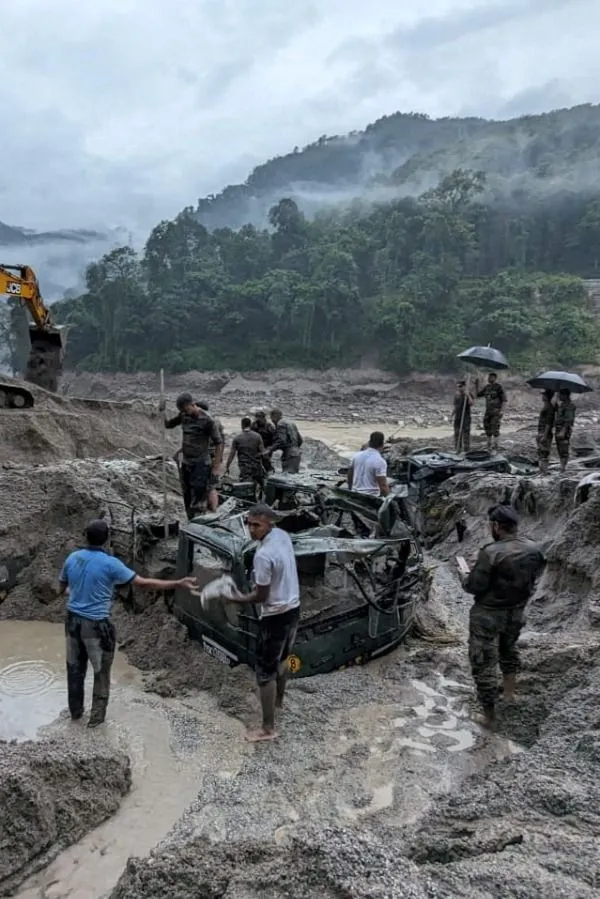
Scale of the Disaster and Ongoing Operations
The glacial collapse, linked to high-altitude ice and rock failure near Mount Langtang Lirung and the upper river reaches, created a tsunami-like wave that devastated towns, villages, roads, bridges, and energy infrastructure on both sides of the border. Hydropower projects along the fast-flowing Himalayan rivers bore the brunt of the damage, as their extensive tunnel networks became death traps or, in rare cases, unexpected shelters. Hundreds of foreign workers, including many Chinese nationals, were among those unaccounted for at the various project sites.
Search and rescue operations have involved the Nepali Army, Armed Police Force, local police, and international experts from countries including South Korea, India, and China. Helicopters and heavy equipment have been critical in reaching remote, debris-choked locations. Authorities have emphasized that efforts continue at multiple tunnel sites and collapsed structures, driven by the recent successful extractions that proved survival remains possible. Relief camps have sheltered thousands of displaced people, while humanitarian appeals seek support for those affected by the loss of homes, livelihoods, and essential services.
Hope Amid Devastation
These successive rescues—first the two Nepali workers, then the Chinese national Luhaitao from the Upper Trishuli-1 tunnel, and the civilian Chandika Shrestha from her Betrabati home—have provided rare moments of hope in an otherwise grim recovery. Each successful operation has reinforced the determination of joint teams to press on, carefully probing tunnels and debris fields for any remaining signs of life. The physical condition of the rescued individuals, ranging from critical injuries to the ability to communicate and accept water, highlights both the extreme hardship they endured and the effectiveness of the coordinated response.
Nepal’s mountainous terrain and reliance on hydropower make the region particularly vulnerable to glacial lake outburst floods, landslides, and extreme weather events intensified by climate pressures. The August 26 disaster has once again illustrated the dual nature of these projects: vital sources of clean energy that also concentrate large workforces in high-risk zones. As recovery shifts toward longer-term reconstruction, the focus remains on accounting for the missing, supporting survivors, and strengthening early-warning and engineering standards to reduce future risks.
The images of Luhaitao being helped from the tunnel and of Chandika Shrestha emerging after more than ten days underground serve as powerful reminders of human resilience. While the full scale of loss continues to unfold, these lives saved offer tangible proof that persistent, professional search efforts can still yield miracles even many days after catastrophe strikes. Operations remain active across the flood-affected districts as teams work to bring any remaining survivors to safety.
Read more – atechsslaash.com , BestMenuHub.com
